
Dental Bridge
Show Off a Comple Smile

Are you missing one or more consecutive teeth? Missing just one tooth can make a huge difference in your quality of life. Things that you once found easy, like chewing your food, speaking clearly, and smiling with confidence, become a challenge. The good news is that at South Jersey Center for Dental Medicine, we offer dental bridges to fill the gap in your smile. To learn more about dental bridges or to find out if one is best for you, give us a call.
What Is a Dental Bridge?
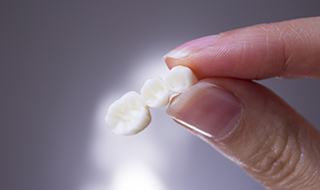
A dental bridge is a restoration that is used to “bridge” the gap in your smile. A bridge works by anchoring on the natural teeth that are on either side of the gap. They are sturdy, lifelike, and can be made from various natural-looking materials that blend in with the rest of your smile.
Types of Dental Bridge
There are two main types of dental bridges that meet different needs. Here is how each one works.
Traditional Dental Bridge
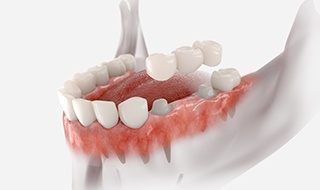
If you have healthy teeth on both sides of the gap, a traditional dental bridge is a good option. The teeth that support the dental crowns are known as “abutment teeth.” Your dentist will remove a small amount of enamel from each of these teeth so your restoration will fit comfortably in your mouth. This type of bridge is usually placed in two visits to the dental office.
Implant Bridge
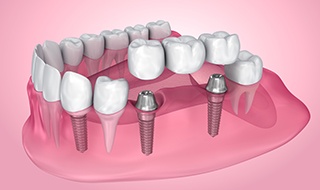
If you don’t have healthy adjacent teeth to support a dental bridge, or if you are missing three or more teeth in a row, dental implants can be surgically inserted to the jawbone to act as supporting teeth. Implant bridges offer additional benefits, like increased stability and longevity in addition to preventing jawbone resorption.
The Benefits of Getting a Dental Bridge

You can experience a wide range of benefits when you choose a dental bridge to replace your missing teeth. Here are some of the most notable ones:
- Prevents dental drift
- Improves chewing ability
- Cost-effective
- Improves speech articulation
- Increases self-confidence
- Lowers risk of oral health issues
Dental Bridges FAQs
Can You Take Out Your Dental Bridge?
No, dental bridges cannot be taken out on their own. Dental bridges are designed to be fixed in the mouth for many years after being placed. Dental bridges can only be done by a dental professional. However, some healthcare providers refer to partial dentures as “removable bridges,” but this isn’t entirely accurate. Partials are similar to dental bridges, but one of the key differences is that partials can be removed by the patient at any time, while bridges cannot.
Is Getting a Dental Bridge Painful?
Before we prepare your teeth to support the bridge, we will start by numbing the area with a local anesthetic. After the preparation and placement of the dental bridge, the underlying teeth will likely feel sensitive for the next few days. Taking over-the-counter pain relievers is usually enough to help. Because dental bridges prevent the surrounding teeth from drifting out of place, they can actually prevent discomfort in the future caused by dental drift.
How Many Teeth Can a Dental Bridge Replace?
Depending on your needs, a dental bridge can replace anywhere from one to four missing teeth in a row. However, in most cases, it is best to use bridges to replace only one or two teeth. The longer that a dental bridge extends, the less stable it becomes, so it can be risky to have a dental bridge replace three or more teeth. Implant bridges can lower this risk because they are just as strong and secure as natural teeth.
How Soon Can You Get a Dental Bridge After a Tooth Extraction?
After a tooth extraction, your gums and jawbone need time to heal, so your dental bridge can’t be placed too soon. The duration of this healing process can vary based on the state of your oral health, but for most people, this takes between eight and twelve weeks. If you are getting a dental implant bridge, it might be possible to have the dental implants placed immediately after your extractions and restored with a temporary bridge during the healing process. During your consultation, we will be able to give you a more specific estimated timeline that applies to your case.
Do Dental Bridges Feel Natural?
Within just a few days of receiving your permanent dental bridge, it should start to feel increasingly natural. Bridges are made from durable materials that can stand up to everyday chewing forces just as easily as tooth enamel, so eating with a dental bridge shouldn’t feel strange. Each bridge is customized based on impressions taken of the tooth, so it shouldn’t feel awkward or even noticeable.
